The townspeople’s belief that the Spackle are extinct
The Knife of Never Letting GoThe townspeople’s belief that the Spackle are extinct is both a conclusion drawn from the dead left in the swamp and a story built around a false account of the Noise germ. Todd first understands the Spackle as a people wiped out after releasing the germ; Ben later reveals that the germ was native to the New World and that human blame helped drive the violence. The belief registers not only the apparent end of a people, but the way an incomplete history can make that ending seem inevitable and justified.
The Swamp and the Received History
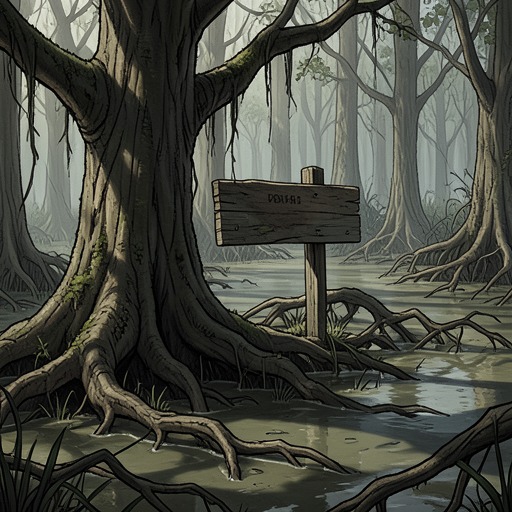
Todd’s earliest account is grounded in the landscape around Prentisstown. The river runs into marshland and then the swamp, where, he has been told, the Spackle buried their dead. Their bodies, according to Ben, suited the water and muck and enriched the swamp rather than poisoning it. That practice changes in Todd’s telling when the number of dead becomes too great for the swamp to absorb: bodies lie in heaps, and the place takes a long time to become swamp again. The physical aftermath offers a stark basis for the belief that no Spackle remain alive.
Todd was born into this aftermath and has no memory of a world before Noise. His father died before he was born, and his mother died as well; Ben and Cillian raised him. Ben says Todd’s mother was the last of the women, although Todd knows that everyone seems to say the same of their own mother. Even this detail carries uncertainty: Ben may believe it, but Todd cannot know whether it is true. His childhood understanding of the Spackle’s fate belongs to the same inherited history, received before he is old enough to question its causes.
Noise and the False Cause
The account Todd initially accepts makes the Spackle responsible for releasing the Noise germ during the war. In that version, the germ killed half the men and every woman, including Todd’s mother; the remaining men went mad, and their violence ended the Spackle. The sequence turns catastrophe into a simple chain of blame: the Spackle bring the germ, human madness follows, and the Spackle disappear. Todd has no firsthand memory against which to test it.
Ben’s later explanation reverses the central claim. The germ was not Spackle warfare: it was already in the air when humans landed on the New World. Within a day, the settlers could hear one another’s thoughts. Ben explains that everything on the planet communicates, that the Spackle evolved to live with this constant information, and that humans were not equipped for it. Too much information could become Noise and drive a man mad. The Spackle were therefore adapted to a condition that overwhelmed the settlers; they did not introduce that condition as a weapon.
Blame and the Making of Prentisstown
Ben places the false accusation within a period of hardship. Crops failed, sickness spread, and prosperity remained out of reach. A poisonous preaching began to blame the Spackle. Todd recognizes the shame in his own response when he names them as the target of that blame. The belief in their culpability was thus not an isolated mistake about the germ: it became part of an account that made persecution possible.
Todd learns that after the Spackle were killed, men in Prentisstown killed the women of the town as well. Ben qualifies the account: not every man took part, but many were swayed by Mayor Prentiss and by Aaron’s preaching that what was hidden must be evil. The killings also included men who tried to protect the women. The apparent extinction of the Spackle sits within a wider history of violence, in which fear of what could not be seen or known was turned against both Spackle and human opponents.
What the Belief Conceals
The history of New Elizabeth further complicates the idea that the past simply ended with the Spackle’s disappearance. Jessica Elizabeth, its Mayor, saw what was coming and organized girls and younger boys to flee across the swamp. Before she could escape with the women and men who had not lost their minds, Mayor Prentiss’s men attacked. Todd understands the result as New Elizabeth becoming Prentisstown. His mother, who had believed in the goodness of others, was too late to flee and gave Todd to Ben and Cillian to keep safe. The community Todd grows up in is therefore not merely a place left after the Spackle are gone; it is also shaped by a human assault that its inherited story does not initially explain.
Todd’s discovery of a place in the swamp where Noise stops makes that inherited certainty falter. He wonders whether the Spackle have returned, even as he recognizes that the silent absence seems impossible. When he tells Ben and Cillian about the place, he asks whether the Spackle are back and whether there will be another war. Ben tells him to keep what happened out of his Noise until he is far enough from town that no one can hear him. The warning shows that the Spackle’s presumed extinction is not a harmless old belief: even the possibility of their return carries danger in a community where thoughts are exposed and the earlier history remains charged.
The novel leaves the question of surviving Spackle unresolved in these episodes. What it does establish is the instability of the town’s explanation: the germ was natural to the New World, and the claim that the Spackle caused it cannot stand. The bodies in the swamp remain evidence of mass death, but they do not make the accepted account of why the violence began true. Todd’s movement from inherited certainty to uneasy questioning turns presumed extinction into a test of how a community remembers its victims, assigns blame, and hides its own part in the past.